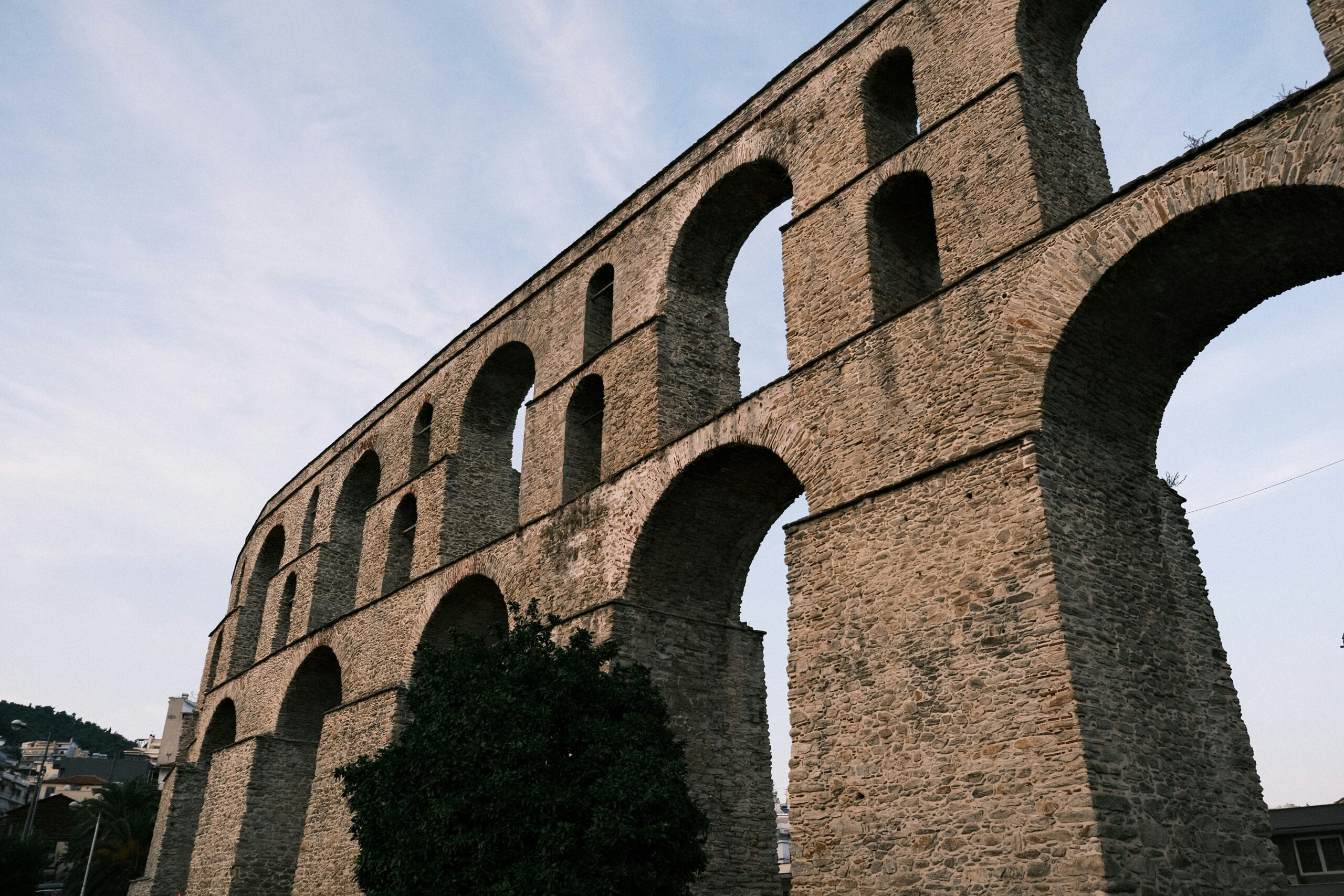
The Old Aqueduct of Kavala, known as Kamares, is one of the city’s most iconic landmarks.
It is an impressive structure 270 meters long and up to 25 meters high, built from local granite and bricks. It features double and, in some parts, triple rows of arches.
While evidence suggests an earlier Roman aqueduct at the same location, the current structure dates back to the 16th century.
It was built between 1520 and 1530 by Ibrahim Pasha, Grand Vizier of Sultan Suleiman the Magnificent, as part of efforts to strengthen the city’s infrastructure.
🔹 Function & Engineering
The aqueduct was designed to transport water from the springs of Old Kavala to the city, covering a distance of approximately 6.5 km through an elevated masonry conduit.
Water was distributed through the Su-Yol (meaning “Water Road”) area, supplying public fountains, baths, and reservoirs.
It remained the main water supply system for Kavala until the early 20th century.
Despite being decommissioned, the structure has been well preserved through regular maintenance over the centuries.
🔹 A Cultural Landmark
Although no longer in use, the Kamares aqueduct remains an architectural marvel and a symbol of Kavala.
Today, it attracts visitors and serves as a historical reference point, showcasing the city’s rich cultural heritage.